CERES : A Dwarf Planet between Mars and Jupiter


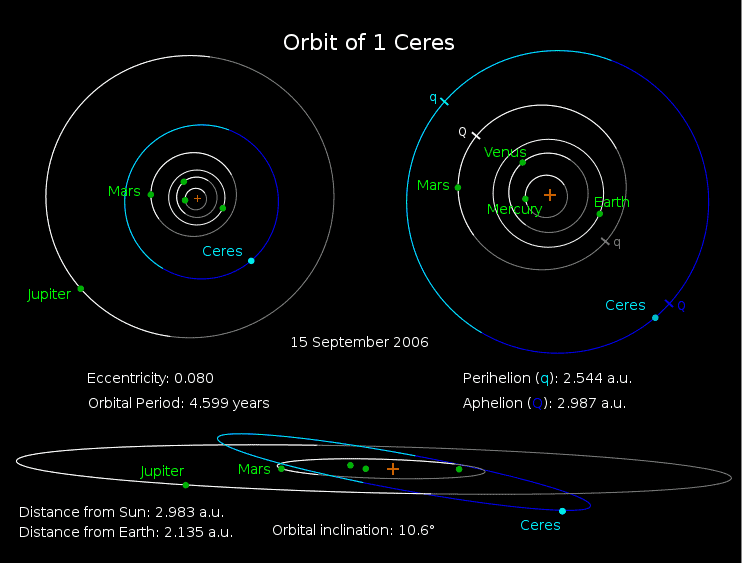
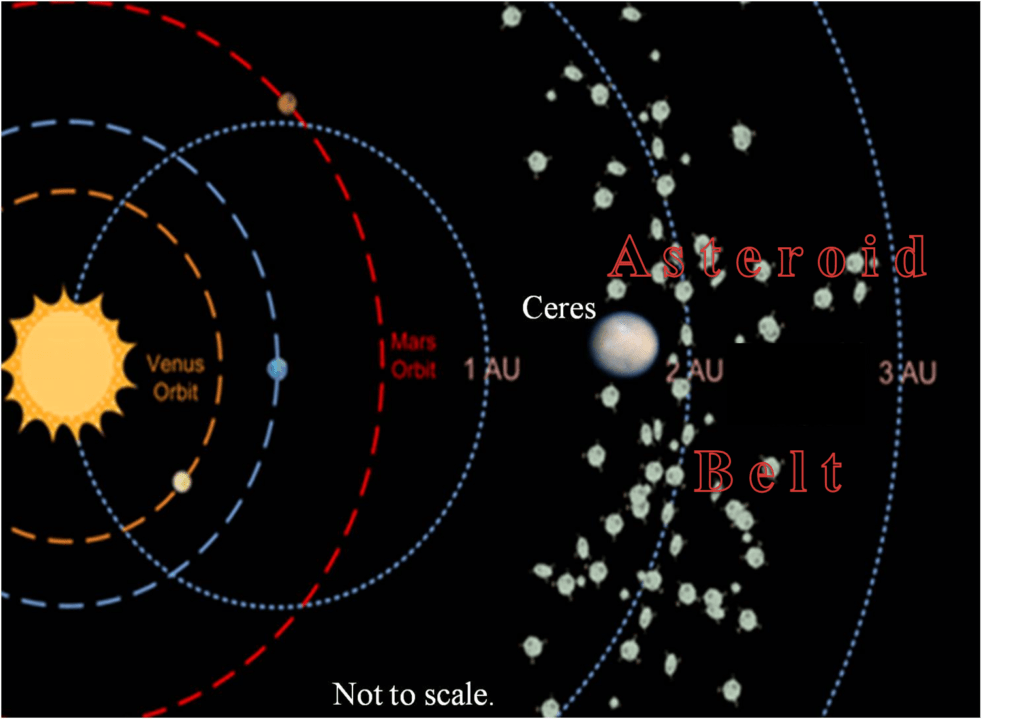
CERES is the largest object in the main asteroid belt that lies between the orbits of mars and jupiter and the only dwarf planet which lies in the inner solar system.
  • Ceres is believed to have been formed around 4.5 billion years ago when the Solar System was forming. Gravity pulled swirling gas and dust and it resulted in the creation of the small dwarf planet.
Is There Life on Ceres? Dwarf Planet Spews Water Vapor
  • It comprises 25% of the asteroid belt's total mass.
  • It is the only object in the asteroid belt currently known to be rounded by its own gravity.
   
  • It takes 4.6 years, to make one trip around the sun and completes one rotation around its own axis every 9 hours.
  • Ceres doesn't have any moons or rings and scientists also believe that it also lacks a magnetosphere.
  • Ceres is named after the Roman goddess of grain crops and harvests. The world cereal comes from the same name.
  • It is the first dwarf planet visited by spacecraft. 'DAWN' reached it in 2015 to study its surface, composition and history. 
  • There’s no evidence of an atmosphere on Ceres, only sporadic water vapor—possibly from ice ejected by small impacts.
  • Using gravity measurements obtained by NASA's Dawn mission, the authors showed that an ascending plume made of a mixture of salty water and rock rose from within the dwarf planet.
Overview | Dawn – NASA Solar System Exploration
  •  Once that material erupted onto the surface, it formed a mountain 2.5 miles (4 kilometers) high and 10.5 miles (17 kilometers) wide. While this process occurred at very cold temperatures on Ceres.
  • Its composition lends itself to the formation of life as we know it. Its prospects for life are positive.
  • Ceres has a mysterious white spot which can be seen in old hubble images and recent images and every second ceres loses 6 kg of its mass in steam which are considered to be plumes of water vapour shooting up from ceres' surface.

Comments

Post a Comment

Popular posts from this blog

Dark Stars: A Brief Introduction

 The early universe was a very different place than it is now. But it may have been the perfect environment for a strange class of giant, puffy stars that used dark matter as fuel . Dark matter annihilations may have fueled some of the universe’s first stars, allowing them to grow into giant, puffy clouds that are millions of times the mass and billions of times the brightness of the Sun. Powered by dark matter, dark stars are hypothetical objects that may have inhabited the early universe. If they existed, these mysterious beasts would not only have been the first stars to form in the cosmos, they also might explain how supermassive black holes got their start. The Dark Star can be explained in three different ways : In case of dark matter -  A  dark star   is a type of star that may have existed early in the universe before conventional stars were able to form. The stars would be composed mostly of normal matter, like modern stars, but a high concentration of n...

LHC : Large Hadron Collider

Large Hadron Collider (LHC) is the largest and most powerful particle accelerator. It was built by CERN, the European Organization for Nuclear Research. It lies in a tunnel 27 kilometres in circumference and as deep as 574 ft, beneath the France-Switzerland near Geneva. The LHC is a particle accelerator that pushes protons or ions to near the speed of light. It consists of a 27-kilometre ring of superconducting magnets with a number of accelerating structures that boost the energy of the particles along the way. The aim of the LHC's detectors is to allow physicists to test the predictions of different theories of particle physics, including measuring the properties of the Higgs Boson and searching for the large family of new particles predicted by supersymmetric theories, as well as unsolved questions of physics. The  LHC  is planned to run  over the next 20 years, with several stops scheduled for upgrades and maintenance work.  It was first shut down...